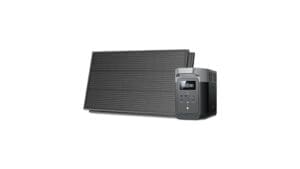
You’ll get a compact 200W/146Wh portable power station with a 40W foldable solar panel, pure‑sine AC outlets, multiple USB ports, and real‑time charge readouts. You can recharge a phone ~24 times, a camera ~12 times, or a laptop ~2.5 times per full charge, but you’re limited to a 200W output and modest solar recharge speed. Wall charging is fastest; car and solar are slower. It’s practical for short trips and emergencies, and more details follow.
Some Key Takeaways
- Compact 200W portable station with 146Wh capacity and included 40W foldable solar panel, ideal for lightweight travel and emergencies.
- Two 110V pure sine AC outlets, four USB ports, and a 12V/8A output support sensitive electronics but limit to 200W combined.
- Real-world runtimes: ~24 phone charges (5W), ~12 camera charges (15W), and ~2.5 laptop charges (50W).
- Wall charging is fastest (5–6 hours); solar charging from the 40W panel requires many sun hours and varies with orientation.
- Strengths: portability, pure-sine output, upgraded BMS; drawbacks: modest 146Wh capacity, 200W cap, and expected long-term battery aging.
Powkey Solar Generator at a Glance : Key Specs and What’s Included
Check the Powkey solar generator’s essentials: a compact 200W portable power station with 146Wh (39,600 mAh) capacity and a 40W foldable solar panel, packaged together with an AC adapter, car charging cable, cigarette-lighter-to-DC adapter, and user manual. You’ll note compact dimensions (7.87 × 1.81 × 5.71 in station; panel 13.98 × 7.68 × 1.57 in) and lightweight portability at 3.0 lbs, so you can carry it easily. Outputs include two 110V pure sine AC outlets, four USB ports, and one 12V DC output. Three recharge methods, real-time indicators, upgraded BMS, and a 12-month warranty complete the package. This kit is well suited for users needing reliable portable power for camping, outdoor activities, or emergency backup.
How the Powkey Performs in Real Use : Runtimes, Device Charge Counts, and Charging Times
When you put the Powkey 146Wh/200W station to work, expect predictable runtimes and clear charge-counts based on device draw: it can recharge a 5W smartphone roughly 24 times, a 15W camera about 12 times, and a 50W laptop around 2.5 times per full charge. In real use you’ll see charge/discharge readouts and four LED indicators that reduce ambiguity. Wall charging takes about 5–6 hours; solar speeds depend on sun and panel orientation. Account for battery aging over years; capacities drop and runtimes shorten. Ignore minor real world noise in readings—averages remain reliable for planning. For backup setups, pairing with portable solar panels designed for generators improves recharge flexibility.
Ports, Outputs, and Device Compatibility : What You Can Realistically Power
Start by matching the Powkey’s outputs to your devices: it provides two 110V pure sine wave AC outlets (200W combined max), four USB ports (up to 5V/3.1A each), and a 12V/8A DC output, so you can reliably run sensitive electronics like laptops and small appliances within the 200W limit while charging phones, tablets, cameras, and USB-powered accessories simultaneously. You should note USB PD limitations — high-watt PD laptop chargers won’t reach full power here. Prioritize loads: run one or two modest AC devices or several USB devices. Check appliance compatibility and the BMS protections before connecting higher-draw gear. When planning for home backup, consider the station’s role in your overall backup power strategy and which essential loads you need covered.
Solar, Wall, and Car Charging Tested : Recharge Times and Efficiency Tips
Although the Powkey gives you three convenient charging methods—wall, car, and the included 40W solar panel—each has predictable trade-offs in speed and real-world efficiency you should account for. Wall charging is fastest: expect about 5–6 hours to full. Car charging is slower and depends on vehicle output and cable quality; plan for longer sessions. Solar charging varies with irradiance; under ideal sun a 40W panel takes many hours, so manage expectations around solar efficiency and peak sun. Use good charging etiquette: prioritize wall for rapid top-ups, avoid frequent shallow cycles, and balance inputs to extend battery life. For users relying on backup generators and portable power setups, consider integrating portable solar gear to increase charging flexibility and reduce generator runtime.
Pros, Cons, and Who Should Buy the Powkey 200W/146Wh Generator
If you need a compact, portable power source for short trips or emergency backup, the Powkey 200W/146Wh generator delivers a clear set of trade-offs: it’s lightweight and outputs clean pure-sine AC suitable for sensitive electronics, supports multiple recharge methods (including the bundled 40W panel), and can comfortably top up phones, cameras, and small laptops, but its 146Wh capacity and 200W limit mean it won’t run high-draw appliances for long or replace a home backup system. Pros: strong portability, safety-focused BMS, multiple ports, solar-ready. Cons: limited runtime, modest battery longevity expectations, and portability tradeoffs versus larger stations. Buy if you value compact reliability. A small unit like this is ideal for portable power needs such as camping, photography shoots, and emergency phone charging.
Some Questions Answered
Does the Generator Support Pass-Through Charging While Simultaneously Powering Devices?
Yes — it supports pass through capability. You can charge the unit via AC, car, or its solar panel while you power devices; the charging behavior shows real-time power updates and AC output status so you’ll know simultaneous input/output loads. The upgraded BMS manages pass-through safely with overload, over-current, over-voltage, and short-circuit protections. You’ll get practical, reliable operation for camping, emergencies, or mobile work while staying connected.
Can I Replace the Internal Battery Myself if It Degrades?
No — you shouldn’t replace the internal battery yourself. The unit isn’t designed for user battery replacement; doing a battery replacement risks voiding warranty and compromising the upgraded Battery Management System. For a safe user upgrade or end-of-life swap, contact Powkey support or an authorized technician who can perform proper battery replacement, preserve safety protections, and maintain warranty coverage while ensuring correct installation and disposal of the old battery.
Is the Solar Panel Weatherproof for Continuous Outdoor Exposure?
No — the solar panel isn’t specified as IP67 rated for continuous outdoor exposure, so you shouldn’t rely on it being fully dustproof and waterproof. You’ll want UV resistance and weatherproofing for long-term placement; without an explicit IP67 rating and manufacturer confirmation, you should store it when not in use or mount it in sheltered locations. This keeps your community of users safe and extends panel lifespan through practical precautions.
Does the Unit Have an App or Bluetooth Monitoring Feature?
No — it doesn’t support Bluetooth monitoring or a mobile app. You get real-time power updates and four LED battery indicators on the unit itself, plus an AC output status light. Rely on the built-in display and indicators for charge/discharge data; there’s no wireless telemetry or companion app for remote monitoring. If you want networked control or app-based alerts, you’ll need a different model or an external smart monitor that integrates with the station.
Are There Airline Travel Restrictions for Carrying This Power Station?
Yes — you can usually bring it on flights as carry-on, but check airline policies first. Because its battery capacity is 146Wh, it falls below the 100–160Wh allowance most carriers permit with approval. You’ll need to declare it at check-in if required, keep it in carry-on (not checked), and make sure terminals are protected. Policies vary by airline and country, so confirm specific rules before travel.