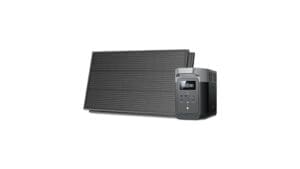
You’ll get a compact 2,048 Wh LiFePO4 power station (expandable to ~4,000 Wh) that’s engineered for heavy use: 2,400 W continuous and 4,000 W peak can run RV A/C, dual-door fridges for ~32–64 hours, and multiple tools simultaneously. Fast AC/solar/800 W alternator charging and smart thermal/load management preserve lifespan and enable quick top-ups. It’s about 25% lighter and 29% smaller than rivals, with robust ports and load prioritization—keep going to see full runtimes, limits, and trade-offs.
Some Key Takeaways
- 2,048 Wh LiFePO4 battery (expandable to ~4,000 Wh) offers multi-day runtimes and long cycle life for backup and off-grid use.
- 2,400 W continuous / 4,000 W peak inverter reliably runs heavy appliances, including many RV/window A/C units and power tools.
- Fast, flexible charging: AC plus solar can fully recharge rapidly, with 800 W alternator support for ~3-hour top-ups.
- Compact and portable at 41.7 lb with a molded handle, smaller and lighter than many 2 kWh-class competitors.
- Rich port selection, load management, and low 9 W standby draw make it practical as primary backup or mobile power source.
Can the Anker SOLIX C2000 Gen 2 Run Your Gear? (Real-World Run-Time Examples)
To see whether the Anker SOLIX C2000 Gen 2 can run your gear, let’s break its specs into practical run-time examples you can compare directly to your devices: the 2,048 Wh LiFePO4 pack (expandable to ~4,000 Wh) and a 2,400 W continuous/4,000 W peak inverter mean you can power high-draw appliances—multiple simultaneously—while still supporting long runtimes for lower-wattage loads; for instance, a dual-door fridge can run about 32 hours on the base battery (up to ~64 hours with the expansion), typical window or RV A/C units that fall under 2,400 W will run but closely approach the continuous limit, and small devices or CPAPs will last many hours thanks to the efficient battery chemistry and low 9 W standby draw.
You’ll plan appliance sequencing to avoid concurrent peaks, use surge management to absorb motor starts, and compare device wattages against the 2,400 W continuous ceiling to guarantee freedom in off-grid scenarios.
The SOLIX C2000 Gen 2 is also a strong choice for portable power users because it integrates well with portable solar generator setups and accessories.
Battery, Capacity, and Longevity Explained : What 2,048 Wh (and a 4,000 Wh Expansion) Means
Although capacity numbers can seem abstract, understanding the C2000 Gen 2’s 2,048 Wh LiFePO4 pack (and the option to nearly double that with a ~4,000 Wh expansion) lets you accurately plan runtimes, cycling, and appliance pairing. You’ll translate Wh into hours for specific loads and compare bank sizes: 2,048 Wh suits long weekends; ~4,000 Wh buys multi-day independence. LiFePO4 chemistry offers predictable cycle lifespan and safer degradation than NMC. Built-in thermal management preserves capacity under load and extends usable cycles. With 9 W standby draw, idle losses are low. Translate these specs to freedom: choose the base or expand to match mission duration. For buyers weighing options, consider generator compatibility and product selection when choosing a lithium battery generator to match your portable power needs.
Power Output and Ports: 2,400 W Continuous, 4,000 W Peak, and What You Can Plug In
With 2,400 W of continuous output and 4,000 W peak capacity, the C2000 Gen 2 lets you run heavy-duty appliances that would overwhelm most portable stations, and its port selection matches that capability so you can distribute loads efficiently. You get multiple AC outlets, USB-C PD ports, and dedicated high current outlets for EV-style draws or induction cooktops. In practice you’ll run an RV A/C and tools simultaneously, unlike smaller units. Built-in load management features let you prioritize circuits and prevent overloads. Compared to peers, the C2000 Gen 2 balances raw power with pragmatic port layout for true off-grid freedom. It’s designed for people who rely on portable power as primary backup, including those who use portable power and backup generators.
Charging Speed and Options : AC, 800 W Alternator, Solar Combos, and Recharge Times
Expect lightning-fast replenishment options that put the C2000 Gen 2 well ahead of most portable stations. You’ll exploit AC optimization for rapid wall charging, combining AC plus solar to reach full in about 58 minutes. Alternator integration at 800 W lets you top the 2,048 Wh pack in roughly three hours — far faster than standard car sockets. Solar prioritization intelligently blends input sources, reducing grid reliance while maximizing throughput. Recharge management gives you selectable modes to balance speed, battery longevity, and source preference. For freedom-seekers, these options mean predictable, high-speed refueling on road or off-grid. Essential gear for reliable use includes portable power stations and compatible accessories to get the most from your setup.
Portability, Size, and Value: Weight, Dimensions, Included Accessories, and Who Should Buy
Anyone who moves a power station regularly will appreciate the C2000 Gen 2’s compact engineering: at 41.7 lb and 18.1 × 9.8 × 10.1 inches it’s about 25% lighter and 29% smaller than comparable 2 kWh-class units, so you’ll find it easier to load into an SUV or stow in an RV compartment without sacrificing output. You’ll notice thoughtful weight distribution around the molded carry handle, improving balance when lifting. Grip comfort is solid for single-person moves; heavy travel cases add protection but reduce that advantage. Included cables and docs deliver immediate value—ideal if you prioritize mobility and off-grid freedom. The site also offers a range of lightweight generators suited for portable and backup power needs.
Some Questions Answered
Is the Battery User-Replaceable After Warranty Expires?
Yes — you can replace the battery after warranty expires, but it’s not as simple as swapping a pack like a flashlight. You’ll want to evaluate battery replacement options, end of life options, and warranty transfer policies before ordering parts or aftermarket services. Compare LiFePO4 modules, connector compatibility, and manufacturer service versus third-party technicians so you keep performance, safety, and freedom to upgrade without being locked into proprietary replacements.
Does It Support Pass-Through Charging While Discharging?
Yes — you’ve got pass through capability: the unit supports simultaneous charging and discharging. You can run loads while replenishing the battery via AC, solar, or vehicle inputs, and the system manages power flow to prioritize load stability and battery health. Compared with many rivals, it maintains high output under charge, so you’ll enjoy continuous operation and greater off-grid freedom without sacrificing recharge speed or appliance performance.
What Protection Features (Like Surge/Overheat) Are Built In?
You get full protection: Battery management actively monitors cells for balance and overcharge protection, while short circuit safeguards and surge limits protect outputs. Thermal throttling kicks in to reduce load if temps rise, and the BMS handles over-discharge, cell balancing, and fault isolation. Compared to simpler stations, you’ll enjoy robust, redundant layers—software and hardware—that maximize safety and let you use the unit freely in varied conditions.
Is It Compatible With Third-Party Expansion Batteries?
No — it isn’t officially supported: you can’t rely on third party compatibility without risk. You’ll find the C2000 Gen 2 designed for Anker’s expansion packs with pinout, BMS communication, and firmware expectations. Using non‑certified batteries may cause incompatibility, reduced performance, or damage, and will likely void warranty implications. If you want flexibility, compare vendors that offer certified companion batteries or request manufacturer confirmation before mixing systems. Anker SOLIX C1000 Gen 2 features advanced battery management capabilities that enhance overall system efficiency. It is essential to ensure compatibility with other components to maintain optimal performance levels. By prioritizing certified equipment, users can avoid potential pitfalls associated with using unverified products.
Can Firmware Be Updated via App or USB?
Yes — you can install firmware updates via the companion app and over USB. You’ll get firmware updates and clear update methods: the app pushes OTA updates for convenience and logs changes, while USB lets you load firmware manually for offline or controlled upgrades. You’ll appreciate the technical transparency: app updates are incremental and automated, USB gives full-image flashing for recovery or advanced troubleshooting, letting you choose the freedom and control you want.