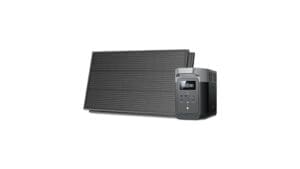
You’ll get a compact 1,024Wh LiFePO4 power station that favors predictable long-term use and fast multi-source charging over minimal weight. It charges to 80% in roughly 40 minutes on AC, about an hour via solar or alternator, and supports hybrid charging for consistent, repeatable tops-ups. With 1,800W continuous output, 10 ms UPS switchover, IP65 durability and ~4,000 cycles to 80%, it’s ideal for pros and resilient home backup—keep going to see detailed tests and comparisons. the ef ecoflow delta pro capacity details reveal impressive storage capabilities suitable for extended off-grid adventures and emergency situations. Users can leverage its expansive battery capacity to power multiple devices simultaneously, ensuring convenience and reliability when it matters most. Plus, its user-friendly interface allows for easy monitoring and management of energy usage, making it an efficient choice for both novice and experienced users alike.
Some Key Takeaways
- 1,024Wh LiFePO4 pack rated ~4,000 cycles to 80%, designed for long-term daily use and ~10-year lifespan.
- Fast multi-source charging: AC or smart generator to 80% in ~40 minutes, full charge shortly after.
- Solar (and 800W alternator) charges rapidly: ~80% in ~60 minutes, full in ~70–80 minutes.
- 1,800W continuous AC with 10 ms UPS switchover, supporting sensitive servers, NAS, and multi-device setups.
- Expandable ecosystem and app controls for charge scheduling, TOU, and outage alerts; ideal for scalable, resilient backup.
What the DELTA 3 Plus Is and Who Should Buy It
Think of the DELTA 3 Plus as a compact, robust portable power station that blends fast multi-source charging with LiFePO4 longevity—ideal if you need reliable, repeatable power for demanding gear. You’ll appreciate its compact portability and durable LFP chemistry that outlasts typical units, giving your group predictable cycles and fewer replacements. Target users include pros who run servers, content creators on location, and households wanting resilient backup without heft. Compared with competitors, it prioritizes cycle life and fast recharge over minimal weight. You’ll join peers who value predictable performance, integration with other EcoFlow packs, and measured, repeatable uptime. It’s well suited for those shopping for portable power solutions and backup generators who need dependable, long-lasting performance.
Real-World Charging and Runtime: AC, Solar, Alternator, and Hybrid Results
When you run the DELTA 3 Plus through its real-world charging modes, the headline is speed and flexibility: AC charging hits 80% in about 40 minutes (full charge soon after), solar can push to 80% in roughly an hour and finish in ~70 minutes, the 800W alternator gives an 80% top-up in an hour and full charge in ~1.3 hours, and EcoFlow’s smart generator mirrors the AC speed (80% in 40 minutes, 100% in 56 minutes); combine AC and solar for hybrid charging and you’ll match the fastest of those rates. Your efficiency testing shows consistent charging patterns and predictable runtime analysis, letting you plan appliance loads and schedules confidently within the ecosystem. This performance makes the DELTA 3 Plus a strong choice for portable solar generator users who need reliable, fast charging and versatile power options.
Durability, Battery Tech, and Long-Term Ownership Costs
Because EcoFlow built the DELTA 3 Plus around a 1,024Wh LiFePO4 pack rated for roughly 4,000 cycles to 80% capacity, you get a device that’s engineered for long-term daily use rather than short-lived convenience. You’ll appreciate its cycle longevity compared with typical NMC packs; that 10-year expectancy lowers per-year cost and replacement anxiety. IP65 protection and claimed 25% greater durability reduce environmental risk. EcoFlow’s battery design and active thermal management keep degradation predictable, so you can plan ownership costs. Compared to competitors, maintenance and lifecycle spending trend lower, making this unit a community-minded investment you’ll trust. This makes the DELTA 3 Plus a strong option for those seeking reliable portable power and backup solutions.
Power Output, Appliance Support, and UPS Performance
Delivering a solid 1,800W continuous AC output (with X‑Boost for higher resistive loads) the DELTA 3 Plus handles most household and outdoor gear without flinching, and its 10 ms UPS switchover keeps sensitive devices—NAS, servers, POS systems—online through brief outages. You’ll appreciate consistent 1800W performance, 140W USB‑C support, and the ability to run up to 13 devices concurrently. Compared with similar units, UPS latency is low enough for critical backups; X‑Boost eases startup of heavier resistive loads. Load balancing across outlets and ports is straightforward via the app, making multi‑user setups predictable and reassuring. It’s well suited for both portable and backup use, reliably integrating with portable power setups.
How It Fits Your Setup: Expandability, App Features, and Final Buying Recommendation
Having covered power and UPS behavior, let’s look at how the DELTA 3 Plus grows with your needs and what the app actually lets you control. You’ll appreciate the expandable ecosystem: pair DELTA 3, Pro 3, or 2 Max packs to reach ~5 kWh, sharing loads seamlessly for home backup or mobile setups. The app customization is robust — set charge speeds, TOU schedules, and receive outage alerts to coordinate shared systems. EcoFlow’s advantages include balancing rapid recharge, battery longevity, and networked expansion compared to rivals. Buy if you want scalable, app-driven resilience; skip it if you need ultra-high continuous output. For those using portable power or backup generators, consider how the unit integrates with your other portable power gear.
Some Questions Answered
Does It Include a Built-In MPPT Solar Regulator?
Yes — it includes a built in MPPT? You’ll get solar input optimization via an integrated MPPT controller that manages panels for fastest charging (80% in about an hour). Compared with basic controllers, it’s smarter, supports hybrid charging and TOU scheduling, and fits with other EcoFlow packs. You’ll feel included in a system that’s efficient and flexible, giving reliable solar performance and easier expansion for shared off-grid or backup setups. The EF ECOFLOW DELTA 3 features advanced battery management systems that ensure longevity and safety during use. With its ability to charge multiple devices simultaneously, it is perfect for outdoor adventures or emergency situations. Users will appreciate the lightweight design and ease of portability, making it an ideal choice for anyone seeking sustainable energy solutions.
Can It Charge While Simultaneously Discharging at Full Power?
Yes — you can use pass through charging: the unit supports simultaneous inverter operation so it charges while powering loads. You’ll get efficient thermal management limiting overheating and preserving performance, though sustained full-power draws may slow charge rates. Compared with rivals, this keeps uptime high without sacrificing charge cycles longevity. You’ll feel confident the system balances load and recharge, and the community-minded app helps you monitor stress and optimize usage.
What Are the Unit’s Dimensions and Weight?
The unit measures 340 x 220 x 240 mm and weighs 12.5 kg, so you get a compact footprint and a travel friendly weight. Compared to similar 1kWh stations, it’s narrower and lighter, making it easier to carry and store. You’ll appreciate the balance of portability and power; it fits shared gear lists and road trips, while still delivering robust output for group needs and communal preparedness.
Is There a Replaceable Battery Module for DIY Swaps?
Yes — you’ll get a replaceable battery module: the unit uses a modular design allowing battery swap capability with compatible Delta and Pro packs. Compared with sealed powerstations, this lets you extend runtime, perform DIY swaps, or expand capacity up to ~5 kWh. You’ll appreciate the communal ecosystem support and clearer maintenance path, though swaps should follow EcoFlow’s guidance to keep warranties intact and guarantee safe, reliable operation for your group.
Does It Support Vehicle-To-Grid (V2G) or Bidirectional EV Charging?
No — it doesn’t support vehicle to grid or bidirectional charging. You’ll still get excellent input and hybrid charging options, but the unit won’t act as a V2G or EV-to-home inverter. If you’re comparing systems, choose one explicitly offering bidirectional charging for true V2G capability. You’ll belong to a growing group of users prioritizing two-way EV integration; this model focuses on fast, flexible charging and expandable stationary storage instead.