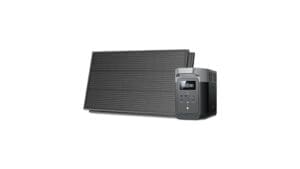
You’ll get a compact K27 that delivers 127W continuous (200W peak) from an 88.8Wh, 2.3 lb battery, with a 30W solar panel, AC/car/solar charging, USB-C/A, DC and QC ports, and an LED light. It’s great for phones, cameras, small fans and short laptop bursts but won’t run kettles or long work sessions; solar charging is slow and heavy draws shorten battery life. Keep going and you’ll find full specs, real-world runtimes, and comparisons.
Some Key Takeaways
- Compact 88.8Wh unit with 127W continuous (200W peak) inverter, best for phones, cameras, and small fans.
- Included 30W solar panel charges slowly and depends heavily on sun; mains/car charging is faster and more reliable.
- Lightweight (2.3 lb) and backpack-friendly, with impact-resistant casing and integrated LED light with SOS mode.
- Limited runtime for heavy loads (kettles, full-size laptops) and frequent deep discharges shorten battery longevity.
- Good budget option for hikers and car campers but not a primary emergency power source compared to 300–1000Wh rivals.
K27 At a Glance: Key Specs and What’s in the Box
Although it’s small enough to tuck into a backpack corner, the K27 packs useful power: a 127W continuous (200W peak) output backed by an 88.8Wh lithium battery and a 30W solar panel. You’ll notice a tidy solar aesthetic and rugged finish that suits outdoor gear. Ports cover AC, USB-C/A, DC and QC needs; charging options include AC, car and the included panel. Safety features and LED lighting add reliability. The box contains the station, panel, AC adapter, car and solar chargers, plus manuals. User testimonials praise portability and design, though some want clearer labeling on ports. It’s a focused offering from a retailer that specializes in portable solar gear and accessories.
Real-World Performance: Battery Capacity, Output Limits, and Charging Times
When you push the K27 beyond light-duty use, its 88.8Wh pack and 127W continuous (200W peak) inverter show clear limits: it’ll comfortably run phones, cameras, and small fans for several charge cycles, but heavier loads like kettles or full-size laptops will either draw it down quickly or trip the peak limit. You’ll appreciate predictable real world runtimes for USB devices, yet battery longevity depends on avoiding deep discharges and frequent high peak draw events. Charging via the 30W panel is slow and can trigger solar throttling under poor sun; mains or car charging gives faster, more reliable recharge cycles. For buyers comparing options, consider total backup goals and battery capacity when choosing a portable power station.
How It Handles in the Field: Portability, Durability, and Lighting Features
After seeing how the K27 performs under load, you’ll want to know how it actually handles on the go. You’ll appreciate the backpack friendly design: compact 6.7×3.1×4 in body and light 2.3 lb weight tuck into pack corners, and the 30W panel stays manageable. Durability is solid — an impact resistant casing, weather resistance, and wide-temp tolerance mean it survives drops and rough trips. The integrated LED offers three brightness levels plus SOS, useful for shared campsites and emergencies. It’s practical for group outings, though you’ll still plan around its modest 88.8Wh capacity. The kit fits well with other lightweight generators enthusiasts looking for portable and backup power.
Ports, Charging Options, and Safety Features Explained
You get a versatile set of outputs and charging options packed into a small unit: two AC outlets, one USB-C, one USB-A, two DC ports, and two QC ports let you run laptops, cameras, phones, tablets, and USB-powered accessories without adapters, while charging comes from three paths—110V mains, a 12V car socket, or the included 18–24V 30W solar panel. You’ll appreciate clear port prioritization: USB-C handles higher-watt devices, QC ports speed-phone top-ups, AC for heavier draws. Six-layer BMS protects against common hazards, but note safety tradeoffs: modest 88.8Wh capacity limits simultaneous heavy loads. Choose the right parallel kit to expand capacity with parallel kit compatibility for generators.
Who Should Buy the K27 and How It Compares to Alternatives
Although compact and convenient enough for hikers and car campers, the K27 best fits users who need light to moderate portable power rather than full off-grid capability. If you’re a budget camper or day-hiker who wants reliable phone, camera, and light charging, it’s a strong choice—lightweight, pocketable, and easy to share within a group. Emergency preppers will appreciate the SOS light and safety features, though capacity limits mean it’s a supplemental unit, not a primary emergency source. Compared with larger 300–1000Wh rivals, the K27 trades runtime for portability and price; pick it if mobility and community use matter. It’s a practical option for those seeking compact portable power solutions for reliable backup charging.
Some Questions Answered
Can the K27 Charge and Run a CPAP Machine Overnight?
Yes — you can run many CPAPs overnight, but check CPAP compatibility and Run time estimates first. With an 88.8Wh battery and 127W (peak 200W) output, you’ll likely power a low-wattage CPAP (without heated humidifier) for roughly 4–8 hours; higher-power units or heated humidifiers will drain faster. You’ll want to calculate your CPAP’s wattage, factor solar input, and test ahead to make certain dependable overnight support.
Is the Battery Replaceable or User-Serviceable?
No, the battery isn’t user-serviceable and you shouldn’t attempt DIY battery replacement. You’ll need authorized service for battery replacement to keep safety features and the six-layer BMS intact. If you value longevity, plan for professional maintenance and check warranty terms before buying. You’ll stay safer and keep community support by using certified repairs rather than opening the unit yourself, preserving performance and protecting against voided warranties.
Does the Unit Support Pass-Through Charging While Powering Heavy Loads?
Yes — the unit supports pass through capability, so you can charge it while running devices, but you should be cautious. If you power heavy loads continuously, the built-in thermal management may kick in to protect the battery and electronics, reducing output or pausing charging. You’ll still get convenience, but you’ll feel safer knowing the six-layer safety system prioritizes longevity and prevents overheating during sustained high-power use.
What Warranties and Customer Support Options Are Included?
You get a Manufacturer warranty covering defects for a set period (check your manual for exact term), and Technical support via the vendor’s helpdesk for setup, troubleshooting, and warranty claims. You’ll feel supported: they’ll guide you through returns, replacements, or repair options. Keep receipts and register the product to speed service. If coverage seems limited, push for clarity—you’re entitled to clear terms and responsive support from the brand.
Can I Connect Multiple K27 Units in Parallel for More Capacity?
Yes — you can’t safely do battery paralleling with K27 units unless the manufacturer explicitly supports it; their specs don’t mention parallel operation or inverter synchronization. You should avoid DIY paralleling because mismatched SOC, voltages, or inverter timing can cause damage or safety risks. Instead, contact support for approved kits or firmware updates that enable synchronized inverters. That way you’ll join a community using safe, supported expansions rather than risking your gear.