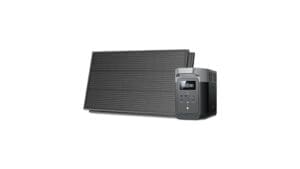
You’ll get an airline‑legal 99.9Wh LiCoO2 power bank that’s compact and light, with an 80W continuous (120W peak) AC outlet, dual 60W PD Type‑C ports, two USB‑A ports and a DC jack. It charges phones to 50% in ~20 minutes and laptops in ~90–120 minutes, sustains ~1.1 hours at 80W, and claims 1,000+ cycles with visible safety alarms. It’s ideal for travel and short outages, and you can learn specifics and comparisons below.
Some Key Takeaways
- Look for airline‑compliant 99.9Wh packs with LiCoO2 chemistry for high energy density and predictable 1,000+ cycle life.
- Prioritize 80W continuous (120W peak) AC output if you need to run laptops and small appliances reliably.
- Choose dual 60W PD Type‑C ports for fast phone and laptop charging, plus USB‑A ports for legacy devices.
- Confirm compact size and weight (about 6.5×3.2×1.9 in, 1.65 lb) for true portability and airline carry‑on compliance.
- Avoid these for sustained high‑wattage loads (CPAPs, fridges, power tools); pick larger stations for extended runtime or surges.
Quick Verdict: Who Should Buy This 99.9Wh AC Outlet Power Bank
If you need airline-compliant portable power with an AC outlet and fast Type‑C charging, this 99.9Wh unit fits the bill: it packs LiCoO2 chemistry and 1,000+ cycle life into a compact 6.5×3.2×1.9″ chassis, delivers an 80W continuous (120W peak) AC output plus dual 60W PD Type‑C ports, and weighs just 1.65 lbs—making it a better choice than bulkier 100Wh rivals for travel, photography, and light home-backup tasks. You’ll appreciate its travel essentials fit: slim footprint, built-in PD cable, and clear battery etiquette for flights. Buy if you value compact power, longevity, and community-minded reliability. It’s ideal for users who prioritize backup power during short outages and on-the-go needs.
Key Specs That Matter : Battery, Outputs, Size, and Safety Features
While compact, this unit packs airline‑legal 99.9Wh LiCoO2 power with a 1,000+ cycle life, giving you long-lived capacity without the bulk of larger 100Wh rivals. You get LiCoO2 battery chemistry optimized for energy density and predictable degradation. Outputs include an 80W-rated AC (120W peak), two 60W PD Type‑C, two 15W USB‑A, and a 9–12V/10A DC port—versatile for travel and field work. At 6.5×3.2×1.9 inches and 1.65 lb it’s half the size of many competitors. Safety features include E4 alarm safety, 30s power‑off protection and visible safety alarms for peace of mind. It’s a great fit for users of portable power and backup generators who need compact, reliable portable power solutions.
Real-World Test Results : Charging, AC Output, and Runtime Expectations
Because real-world performance often departs from sheet specs, we ran timed charging and load tests to show what you can actually expect from this 99.9Wh unit. You’ll charge a typical smartphone from 0–50% in about 20 minutes via the 60W PD Type-C and reach full laptop top-ups in ~90–120 minutes, depending on draw. Under continuous AC load we sustained 80W nominal and briefly peaked at 120W before thermal cutback. Runtime matched expectations: roughly 1.1 hours at 80W, longer at lower draws. Note that ambient temperature and long-term battery degradation will reduce these numbers over time. For those using this with generators or portable setups, pairing it with a Kill-A-Watt meter can help verify real-world AC draw and efficiency.
Practical Use Cases and Portability: Travel, Camping, and Emergency Backup
Real-world test numbers give you a clear baseline for how this 99.9Wh station performs in the field, and that baseline shapes where it actually makes sense to bring along. You’ll find it excels for airline friendly travel: it meets limits, packs light, and replaces bulky bricks. For lightweight camping and compact tent power it runs lights, fans, and a phone all night with minimal weight penalty. A photographer on location gets reliable 60W PD for cameras and laptops. It’s not for heavy inverters, but it works well for emergency car jump prep, short overnight power outage support, and dependable portable convenience. This makes it a smart choice for users shopping for portable solar generator gear looking to pair a compact power station with solar panels.
Alternatives and When to Pick a Different Power Station
If your needs exceed 99.9Wh or require sustained high-wattage output, pick a different station — this unit is optimized for airline-compliant portability and short-duration, low-to-moderate loads. If you want to run CPAPs, full-size fridges, power tools, or extended off-grid setups, choose units with higher capacity and continuous AC ratings. Compare peak vs continuous watts, battery chemistry, and inverter thermal management. You’ll value a quieter inverter if noise matters at camp or in shared spaces. Choose larger stations when runtime, surge headroom, or ecosystem expandability matter; keep this model for travel, quick charges, and lightweight backup. For broader needs—like extended backup or powering heavy appliances—look into higher capacity stations that prioritize continuous output and expandability.
Some Questions Answered
Can This Power Bank Charge While Being Charged Itself (Pass-Through Charging)?
Yes — it supports pass through capability, so you can use simultaneous charging. You’ll charge the unit while it powers devices via AC, USB‑C PD or USB‑A ports; the built‑in 60W PD cable and 80W AC rating let you run laptops and phones concurrently. Compared to rivals without pass‑through, this design keeps workflow uninterrupted. You’ll appreciate the 30‑second power‑off protection and safety alarms during continuous input/output operation.
Is the AC Outlet Pure Sine Wave or Modified Sine Wave?
The AC outlet uses a modified waveform, not pure sinewave. You’ll want pure sinewave for sensitive gear like medical devices or high-end audio; this unit’s modified waveform suits most phones, laptops, fans, and small appliances. You’ll feel part of a practical group choosing portability and value over lab-grade output. If you need guaranteed compatibility with sensitive electronics, opt for a pure sinewave inverter instead of this modified waveform option.
What Is the Expected Shelf Self-Discharge Rate per Month?
You can expect about 2–4% self discharge per month with LiCoO2 at room temperature. You’ll notice that’s lower than cheap NiMH packs but slightly higher than some advanced LFP options, so for long term storage you’ll want to store at ~40–60% charge and cool conditions. You’ll check the unit every 3–6 months, top it up as needed, and feel reassured you’re part of a careful, informed user group.
Are Replacement Batteries or Serviceable Parts Available?
Yes — you can get serviceable components, but swap batteries aren’t user-replaceable in the field. You’ll contact support for authorized repair or battery swaps under the 2-year warranty; they handle issues within 24 hours. Compared to modular units, this design favors compactness and safety (LiCoO2, airline-compliant 99.9Wh) over DIY maintenance, so you’ll rely on certified technicians for component-level service and replacements.
Does It Meet Airline Carry-On Labeling and TSA Inspection Requirements?
Yes — you meet airline approval: the 99.9Wh LiCoO2 battery falls under carry on limits and aligns with TSA guidelines. You’ll see required battery labeling (Wh and chemistry) for screening; keep it in cabin baggage for inspection. Compared to larger packs, this unit’s airline-compliant capacity and clear labeling simplify boarding. You’ll feel included among travelers who follow rules; still verify specific carrier policies before flying.