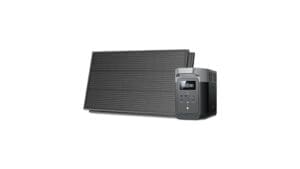
You’ll get a tough, fast-charging 1,024 Wh LiFePO4 power station with an 1,800 W inverter that’s built for whole-home backup portability, long life, and reliable UPS performance. It runs laptops, lights, fridges, and most tools, handles 3,600 W surges, and charges via AC at 1,200 W or combined AC+solar for near‑full in under an hour. It’s lighter and smaller than rivals, bundles a 100 W panel, and lasts years—keep going to see full test details.
Some Key Takeaways
- 1024 Wh LiFePO4 battery with 1800 W continuous inverter and 3600 W surge supports most home appliances and tools.
- Fast charging: AC up to 1200 W (≈1 hour), AC+solar can reach 0–100% in about 41 minutes.
- EPS/UPS transfer under 0.01 s ensures uninterrupted power for sensitive electronics.
- LiFePO4 chemistry offers >3,500 cycles and up to 15 years of service with robust BMS safety features.
- Portable 12 kg design, bundled 100 W solar panel, and competitive pricing make it strong value for backup and camping.
Quick Verdict : Who the P1000 Plus Is Best For
While the P1000 Plus is powerful enough for whole-home backup, it’s best for users who need high capacity in a surprisingly portable package—think homeowners prepping for outages, RVers and campers who want reliable overnight power, and small teams running tools or office gear off-grid. You’ll appreciate its 1024Wh LiFePO4 cell chemistry, 12 kg carry weight, and fast recharge when you compare it to bulky rivals. It suits camping couples who want dependable warmth and lights and emergency preppers seeking longevity and cycles. You’ll feel part of a practical community that values durable, movable, high-capacity power. It’s an excellent choice for those focused on portable power solutions and backup generators.
Real-World Power and Ports : What 1024Wh, 1800W Continuous Really Runs
Because the P1000 Plus pairs a 1024 Wh LiFePO4 pack with an 1800 W continuous inverter, you can run a wide range of household and outdoor gear without oversizing—expect to power laptops, lights, fridges, electric blankets and most power tools within that 1800 W envelope, and handle short surges up to 3600 W for motor starts. You’ll realistically run a mid-size fridge for ~12–18 hours, charge multiple laptops and phones, and operate drills or saws intermittently. Port selection supports simultaneous device groups; USB-C PD handles fast laptops, AC outlets suit heavy loads. This balance optimizes appliance longevity while demonstrating solid peak handling. It’s a good fit for users building a portable solar generator setup.
Charging Speed and UPS Behavior : AC, Solar, Combined Charging, and EPS Transfer?
Having established what the P1000 Plus can run, let’s examine how fast and reliably you’ll get that power back—considering its power management features from AC, solar, and combined inputs, and how the EPS handles outages. You can top up from AC at up to 1200 W, reaching full in ~1 hour; combined AC+solar (1200 W + up to 500 W) hits 0–100% in ~41 minutes. Solar alone is limited by panel output and occasional Solar throttling, so expect slower, variable rates. EPS transfer is under 0.01 s, so AC latency won’t interrupt sensitive gear. Overall, charging is aggressive and UPS behavior is dependable. This is a useful consideration when choosing portable power for use with kill a watt meters and backup generators.
Battery Life and Safety : LiFePO4 Longevity, BMS, and Expected Service Life
Longevity matters, and the P1000 Plus delivers: its LiFePO4 chemistry gives you over 3,500 full charge cycles and an expected service life up to 15 years, which outpaces conventional NMC cells by a wide margin. You’ll appreciate LiFePO4 longevity for lower degradation and predictable capacity retention over years. The integrated BMS monitoring and MCU actively balance cell voltages, control temperatures, and prevent overcharge, overdischarge, and short circuits. Compared to typical consumer packs, this system reduces failure modes and maintenance needs. If you want a reliable community power solution, the P1000 Plus offers transparent, long-term safety and endurance. For users who rely on portable setups, pairing the P1000 Plus with the right charger choices can optimize charge times and overall system performance.
Portability, Bundle Contents, and Value Compared to Rivals
While it’s still hefty compared with small battery packs, the P1000 Plus strikes a practical balance between capacity and portability—you can reasonably carry its 12 kg frame to a campsite or swap it between vehicles without special equipment. You’ll appreciate the compact handle and 23% smaller footprint versus similar-capacity rivals, making group trips feel inclusive rather than logistical. The bundled 100W solar panel, charging cables, and two-year support add tangible value since panels ship separately for safety. Compared to competitors, competitive pricing plus LiFePO4 longevity and fast charging gives you more uptime per dollar, straightforwardly. The package aligns well with common needs for portable power users seeking reliable backup and outdoor energy solutions.
Some Questions Answered
Does the Unit Support Pass-Through Charging While Powering Heavy Loads?
Yes — you can charge and run heavy loads simultaneously. You’ll get continuous operation with bi-directional inverter support, AC+solar fast charging and EPS transfer under 0.01 s. Expect smart thermal management and BMS to throttle input/output if temperatures rise, so performance stays safe. Compared with similar units, it balances fast replenishment and longevity, and you’ll feel confident using it for household or outdoor heavy-duty needs together with charging.
Can I Expand Capacity With Additional Battery Packs?
Yes — you can’t expand capacity directly: the unit lacks external modularity for adding dedicated battery packs, so you won’t plug extra modules into it. You can, however, parallel external batteries via compatible inverters or UPS setups, but watch compatibility limits — voltage, communication protocols, and warranty implications. Compare setups carefully; choose solutions tested by the community or vendor so you’ll feel confident and included in reliable, supported expansion options.
Is There a Mobile App or Bluetooth Monitoring Feature?
Yes — you can use a Bluetooth app for remote monitoring. You’ll connect the power station via Bluetooth app to view real-time stats, charging, and discharge data. Compared with units lacking connectivity, this gives you clearer control and peace of mind. You’ll appreciate shared access for family or team management, letting everyone stay informed. It’s a practical, inclusive upgrade for efficient oversight and collaborative use.
What Warranty Covers Battery Degradation Over Time?
You’re covered by a 2-year battery warranty; the degradation policy typically guarantees replacement or repair if capacity falls below a specified threshold within that period. You’ll want to compare terms: some warranties guarantee a minimum percentage of original capacity, others focus on manufacturing faults. Join other users by checking the fine print for exclusions (abuse, improper charging). Contact support with cycle data and proof of purchase to invoke the warranty.
Are Replacement Fuses or Service Parts Available Locally?
Yes — you can usually source replacement fuses and some service parts from local suppliers, and OUKITEL’s support can guide ordering harder-to-get modules. You’ll find DIY repairs are feasible for simple swaps, though complex battery or BMS work is better handled professionally. Compare local availability and cost versus OEM shipping; join owner groups to share trusted vendors and repair tips so you’re supported while keeping repairs practical and community-driven.